Lenkiewicz Arts And Jewellery
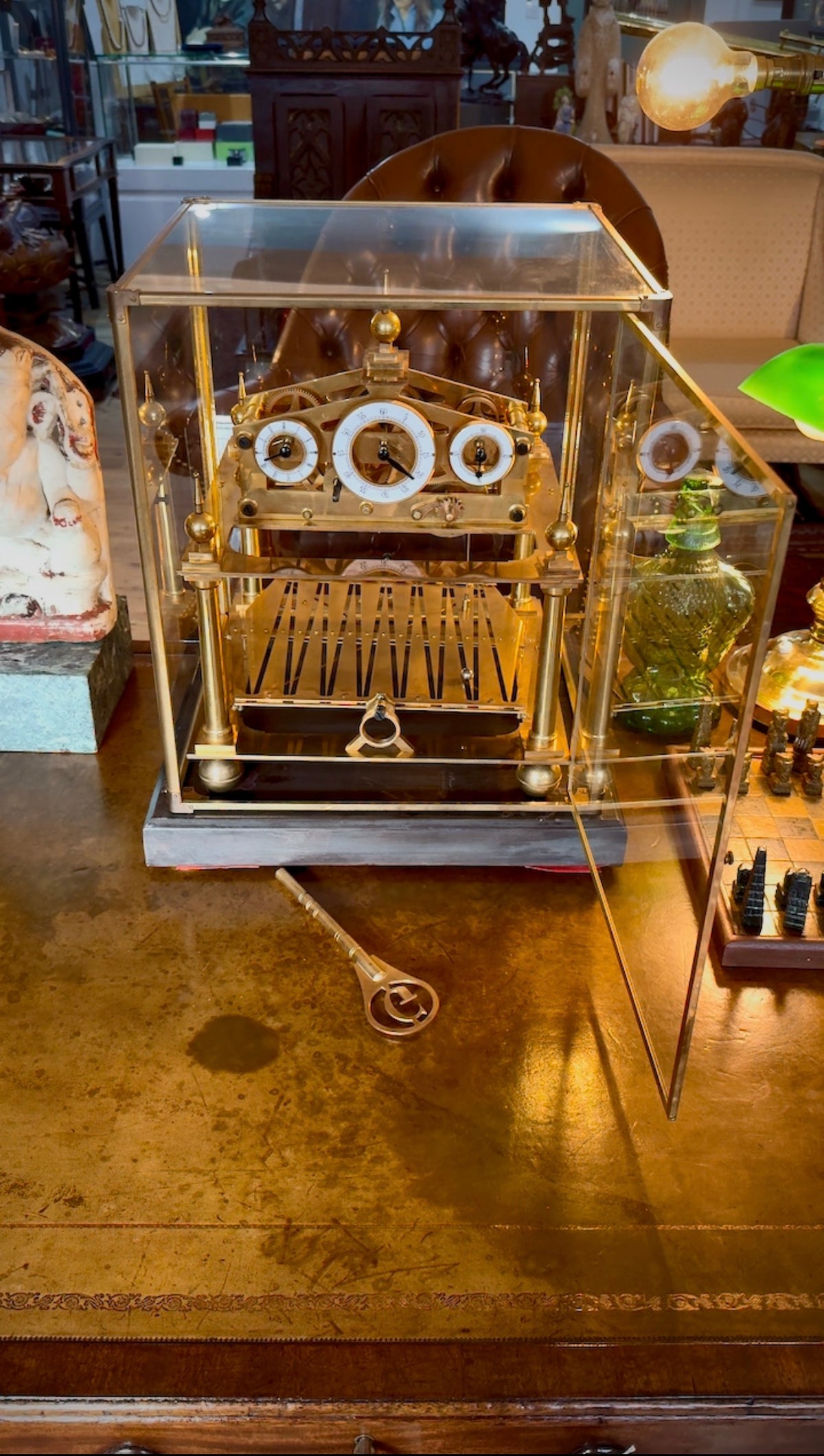
A Congreve Rolling Ball Skeleton Clock in Glass Display Case
A Congreve Rolling Ball Skeleton Clock in Glass Display Case
Couldn't load pickup availability
Share
A Congreve clock (or rolling ball clock) is a mechanical clock invented by Sir William Congreve in 1808 that uses a ball rolling along a zigzag track instead of a pendulum to regulate time.
How It Works
A small ball rolls down a grooved or zigzag path on a tilting plate or platform, typically taking between 12 seconds and one minute to complete a run.
At the end of the track, the ball trips a lever or buffer rod that unlocks the escapement.
The escapement advances the clock hands (often jumping 15 or 30 seconds at a time on second dials) and reverses the tilt of the track so the ball can roll back.
History and Accuracy
Inventor: Sir William Congreve (1772–1828), an artillery officer and inventor best known for Congreve rockets, patented the rolling ball timekeeping principle in 1808.
According to The Royal Collection Trust, the escapement proved troublesome.
Because dust, friction, and surface variations affect how fast the ball rolls, Congreve clocks are novelties rather than precision instruments—O. Comitti & Son Ltd notes accuracy can vary by roughly ±15 minutes per day.
Examples can be seen in museum and historic collections, including the Royal Collection, the British Museum, and National Trust Collections.
Modern Clocks and Pricing
Modern reproductions and limited editions—such as models by Comitti of London, Thwaites & Reed, and miniature brass versions—are sold for collectors.
Prices vary widely depending on maker, age, and condition, generally ranging from around £2000 for smaller skeleton/antique-style pieces to over £13,700 for new luxury editions.
Congreve appears to have been unaware that rolling ball clocks had been invented earlier by both Nicolas Grollier de Servière and Johann Sayller. Congreve's version differed from Grollier's rolling ball clock in that the ball travelled down a zigzag rather than straight path.
While Sayller's version had also used a zigzag path, it had utilized a number of balls and a fixed table rather than the single ball and tilting table employed by Congreve.
The "Extreme Detached Escapement" (as Congreve referred to his escapement design) was patented in 1808. Congreve, who was not a clock maker, hired Gravell & Tolkien to produce the first working version, which he then presented to the Prince of Wales in 1808.