Lenkiewicz Arts And Jewellery
Europa and the Bull By Salvador Dali
Europa and the Bull By Salvador Dali
Couldn't load pickup availability
Share
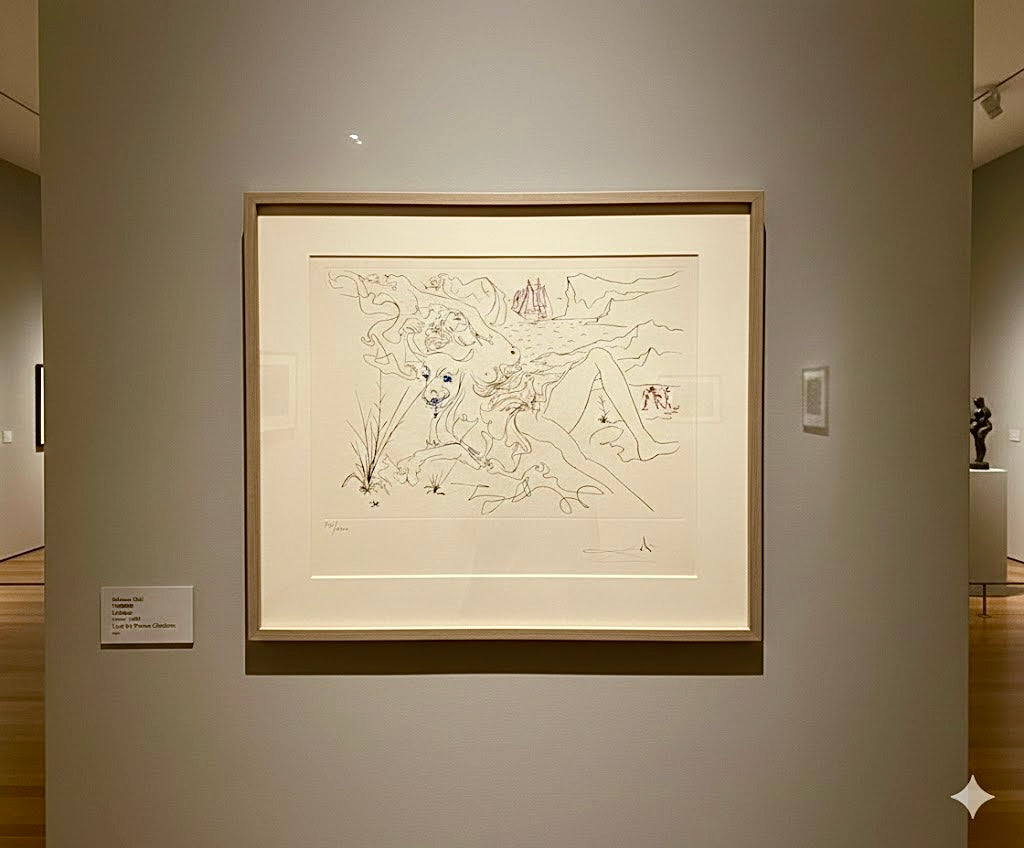
This etching, titled "Europa and the Bull", is a celebrated work from Salvador Dalí’s "Famous Loves" (Les Amours Célèbres) suite, published in 1972.
It illustrates the Greek myth where Zeus, disguised as a majestic white bull, seduces and abducts the Phoenician princess Europa, carrying her across the sea to Crete.
The Bull (Zeus): In typical Dalí style, the bull is not a solid beast but a collection of fluid, calligraphic lines. He appears almost as a ghostly or cloud-like presence, merging with the landscape and the sea.
-
Europa: She is depicted as a reclining, ethereal figure. Her form is delicate, with long, elegant limbs that seem to float rather than rest.
-
The "Blue Eyes": You'll notice a face integrated into the composition—often interpreted as Zeus or a watchful subconscious presence—characterized by piercing blue eyes. These provide the only significant pop of color in the otherwise monochromatic line work, drawing the viewer's gaze directly into the "mind" of the piece.
-
The Maritime Setting: A classical sailing ship sits on the horizon. For Dalí, ships often symbolized the passage of time, the unconscious, or a longing for his coastal home in Cadaqués. Here, it also underscores the "voyage" aspect of the myth.
Technique and Style
The work is a color etching (drypoint). During this period (the early 1970s), Dalí moved away from the heavy realism of his earlier paintings toward a "spontaneous" graphic style
-
Line Work: The "spindly" and "nervous" lines give the etching a sense of movement, as if the scene is shifting or vibrating before your eyes.
-
Symbolism: By making the figures semi-transparent, Dalí emphasizes the metamorphosis—a central theme in his work—suggesting that the characters are not physical beings but psychological entities or dreams.
Collector's Context
-
Suite: Part of the Famous Loves series, which also included pairs like Anthony and Cleopatra and Samson and Delilah.
Edition: This was a large release for Dalí, usually numbered out of 1,000 (plus artist proofs), making it one of his most widely recognized and accessible graphic works in galleries today