Lenkiewicz Arts And Jewellery
French Ebonised Boulle Bonheur -Du-Jours.
French Ebonised Boulle Bonheur -Du-Jours.
Couldn't load pickup availability
Share
A Near Pair of Beautiful French Ebonised Boulle Bonheur -Du-Jours.
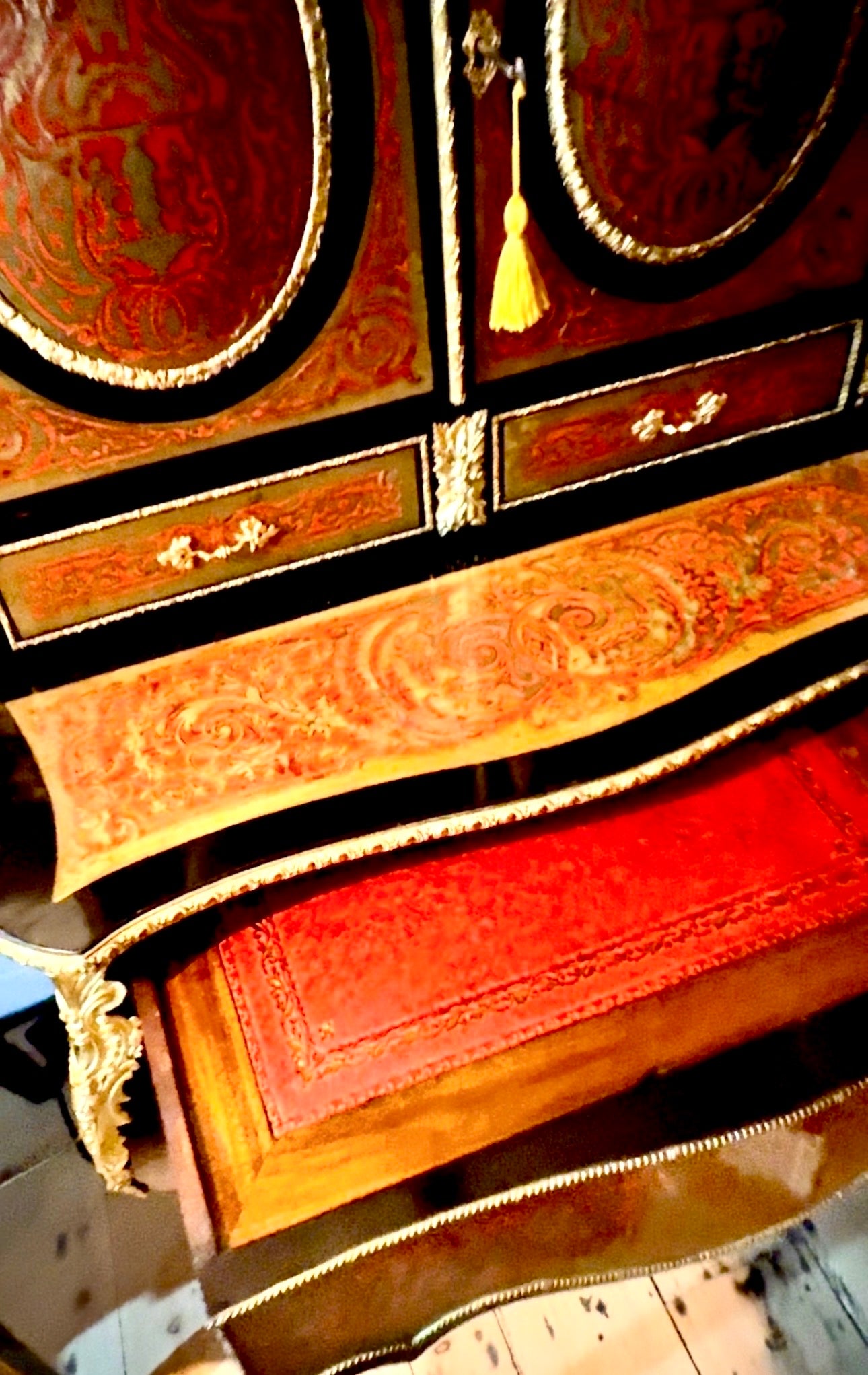
A rare pair of stunning cabinets with brass galleried tops, two cupboard doors with working lock and key, opening to reveal a red-lined interior with a shelf.
Two drawers to the base, the top drawer containing writing slides, one in red tooled leather, the other plain.
Beautiful, elegant cabriole legs terminating in gift brass sabots.
Lovely ormolu gilt mounts.
Please see further info regarding Boulle below
Wonderful condition.
Circa 1860.
History: Boulle furniture is an opulent style of 17th-19th century French furniture defined by intricate marquetry, primarily featuring tortoiseshell inlaid with brass, pewter, and sometimes mother-of-pearl or horn. Named after André-Charles Boulle (1642-1732), court cabinetmaker to Louis XIV, these pieces are often adorned with gilded bronze (ormolu) mounts.
Key Characteristics and Techniques
- Materials: Typically uses a base of tortoiseshell (often red or dark brown) with inlaid brass or pewter, frequently on an ebonised wood frame.
- Boulle Marquetry: The technique involves cutting designs from both materials simultaneously, creating two versions: "part" (brass on tortoiseshell) and "counterpart" (tortoiseshell on brass).
- Style: Originally developed in the Baroque and Rococo periods, it is highly decorative with arabesque, scroll, and floral patterns.
- Ormolu Mounts: Pieces are frequently adorned with elaborate bronze gilt mounts (mascarons, claws, foliage) designed to protect corners and edges.
- Types: Common pieces include cabinets (cabinets-vitrines), credenzas, desks, clocks, and commodes.
Historical Significance and Legacy
- dre-Charles Boulle (1642-1732): He did not invent the technique but perfected it, earning the title Premier ébéniste du Roi (First Cabinetmaker to the King).
- Usage: Created for royalty and high nobility, with significant pieces originally commissioned for the Palace of Versailles.
- 19th Century Revival: The style saw a massive revival during the Napoleon Ill period (circa 1850-1870), leading to many high-quality reproductions and new pieces in this style.