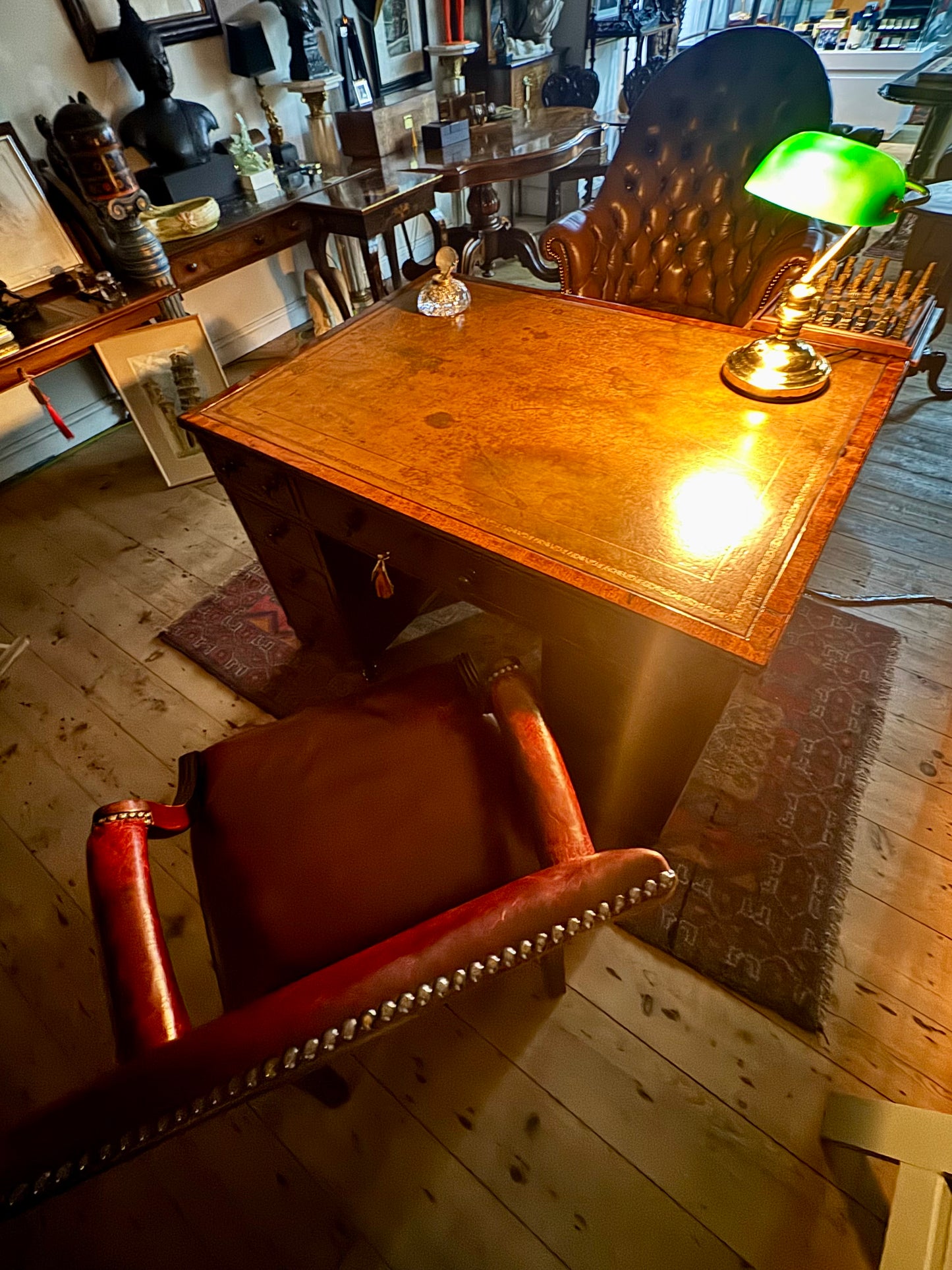
A Gillows partners table (or desk) is a highly collectible 18th-19th Century double sided table crafted by the renowned English cabinet makers Gillows Of Lancaster and London. Famous for dual-sided functionality, they feature drawers and cabinets accessible from both sides, premium imported timbers, and exceptional hand-carved detailing.
VALUATION AND CURRENT MARKET
Because of their historical significance and master craftsmanship, these tables command a premium at auction and in antique markets. Pricing typically ranges from $20,000 to over $30,000, depending on the rarity of the wood, condition, and specific period (such as George IV or William IV).
DESCRIPTIONS:
A Gillows George Partners Pedestal Desk of Small Proportions.
This impressive Mahogany partners desk made by one of the best makers, Gillows, is an exceptional piece. (Stamped on drawer) Gillows Of Lancaster.
Original leather-lined top with three drawers on either side sits on two pedestals, one side with drawers, the other with cupboards.
Full working locks and keys in all drawers. Circa 1830.
It was founded in Lancaster in about 1730 by Robert Gillow (1704-1772). Gillows was owned by the family until 1814 when it was taken over by Redmayne, Whiteside, and Ferguson; they continued to use the Gillow name.
Gillows furniture was a byword for quality, and other designers used Gillows to manufacture their furniture.
Gillows furniture is referred to by
Jane Austen,
Thackeray,
First Lord Lytton,
Gilbert and Sullivan's comic operas.
Gillows notably made heavy use of mahogany wood, which is indigenous to the Americas, from the early 1730s. In the early 1740s, Gillow owned a twelfth share of the ship Briget, which he partially used to import mahogany from the West Indies.
The success of the firm was partly due to his ability to directly import mahogany; by 1742 Gillow was exporting finished mahogany furniture back to the West Indies.
The family's Catholic history was important in building up a customer base within Lancashire's gentry, and their subsequent purchase of Leighton Hall, Lancashire from a cousin in 1822.
Goodison and Hardy state that the firm opened a London branch in 1760 at 176 Oxford Road. By 1775 the Lancaster branch had 42 employees, and by 1789 there were about 50 employees.