Lenkiewicz Arts And Jewellery
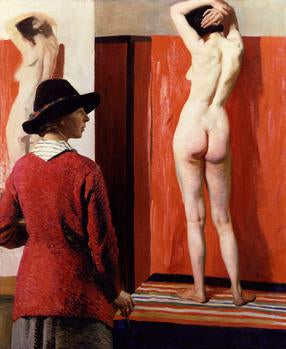
Nude Of Artist In The Studio By Dame Laura Knight
Nude Of Artist In The Studio By Dame Laura Knight
Couldn't load pickup availability
Share
She continued to be a prominent artist throughout her life, even acting as an official war artist during the Nuremberg trials.
Description
Dame Laura Knight
Nude Model in the Studio watercolour with gouache and pencil
Framed and mounted 28 by 23cm., 11 by gin
Condition Excellent
Laura Knight is best remembered for being the first female artist to be elected a full member of the Royal Academy in 1936 200 years after its establishment. She was made Dame in 1929 and in 1965 she became the first woman to have a large-scale retrospective at the Royal Academy.
Although Knight was eventually recognised as the most prodigious female artist of her generation, her path to success was far from straightforward. Knight grew up impoverished and was only able to attend Nottingham School of Art on account of a bursary.
As a female, Knight was excluded from life drawing classes and only allowed to study the nude from plaster casts.
Through her masterful talent, enduring determination and later institutional recognition she heavily contributed to elevating the status of the female artist.
In 1913, Knight painted the revolutionary painting, Self Portrait with Nude. This subversive self-portrait was the first instance in the history of art of a painting depicting a female artist engaging in the practice of life drawing.
This historically significant painting challenged the widespread barring of female students from life drawing classes. The work proved too daring for the Royal Academy, who rejected it. When finally exhibited at the Society of Sculptors, Painters and Gravers in London, the critic from The Daily Telegraph described it as 'vulgar'.
Knight once commented that 'a female artist is considered more or less a freak', a view born out by the views of the aforementioned critic.
However, by creating works such as this, Knight was actively opening up a vital dialogue and encouraging a reassessment of the position of women within the art world.
This watercolour depicts the naked artist casually tidying her study - which may relate to the famous and groundbreaking painting Self Portrait with a Nude.
Knight continually fought her figurative training and she strived to rid her work of the stillness of her plaster-cast studies from art school.
She spent a large part of her career striving to capture the complex figurative movement of performers within the theatre, circus and ballet: the gravity-defying bodily contortions of trapeze artists, the dramatic movements of actors, and the elegant yet fast-pasted dynamism of ballerinas.
She once commented: 'I firmly believe the most valuable study I have ever had was in my attempt to draw the Ballet.
Never before had I tried to make the pencil speak in a language of its own'.
Knight became deeply involved with her subjects,
'traveling with the circus, camping with gypsies, setting up easels in circus rings, hanging over the stalls in Covent Garden, sleeping under tent flaps, recording on canvas her impressions of the entertainment world. The artist relished depicting the contrasting stages of a performance: the frenzied preparation in the dressing room, the quiet anticipation of figures off-stage, and the magnetic excitement of the show.
Knight was also drawn to the entertainment industry as it was much more of an equal playing field for working females. Knight was captivated by the leading female ballet stars, including Anna Pavlova and Tamara Karsavina: 'For Knight, they were more than performers; they embodied the female artist at the very summit of her profession, a position Knight herself had not yet achieved, but knew would be within her grasp'
Through her dressing room scenes, Knight captured intimate pictures of performers being prepared for their show. One of Knight's biographers commented that
'Laura was undoubtedly happiest when painting informal scenes backstage' These intimate encounters led to Knight forming close friendships with fellow females in the arts.
This watercolour was painted in Knight's studio at 1 Queens Road London which she transformed into a dressing room for the circus-stars who had finished their season at Olympia in Kensington but stayed in London to pose for the picture.